Lao PDR
When: 2024–2026
Purpose: Use integrated climate, land, energy, and water planning to support Lao PDR’s forest-cover and green-growth goals while safeguarding food security and strengthening climate resilience.
Project development: An introductory CLEWs workshop was held in Vientiane from 11–15 November 2024, followed by advanced training from 5–7 May 2025. The second workshop brought together more than 30 representatives from government, academia, and technical agencies to review the Lao PDR model, refine its assumptions, and identify priority scenarios on smart agriculture and the management of water for energy and food production. The resulting analysis was published in policy and technical briefs dated June 2026.
June 2026 findings: The scenarios examine how Lao PDR could pursue its conditional target of 70% forest cover while meeting growing food demand. The results are modelled pathways rather than forecasts.
- Use existing farmland more productively instead of expanding it. In the modelled pathway, increasing irrigation and mechanization could produce an additional 420,000 tonnes of rice per year by 2055 while freeing about 8,000 km² of land for other uses, including forest restoration.
- Plan farming, water, and electricity infrastructure together. Agricultural intensification raises modelled irrigation-water needs by 51% and electricity needs for irrigation by 34% by 2055. Efficient irrigation and pumping systems, careful management of local water resources, and a modest increase in solar and wind generation can help meet those needs.
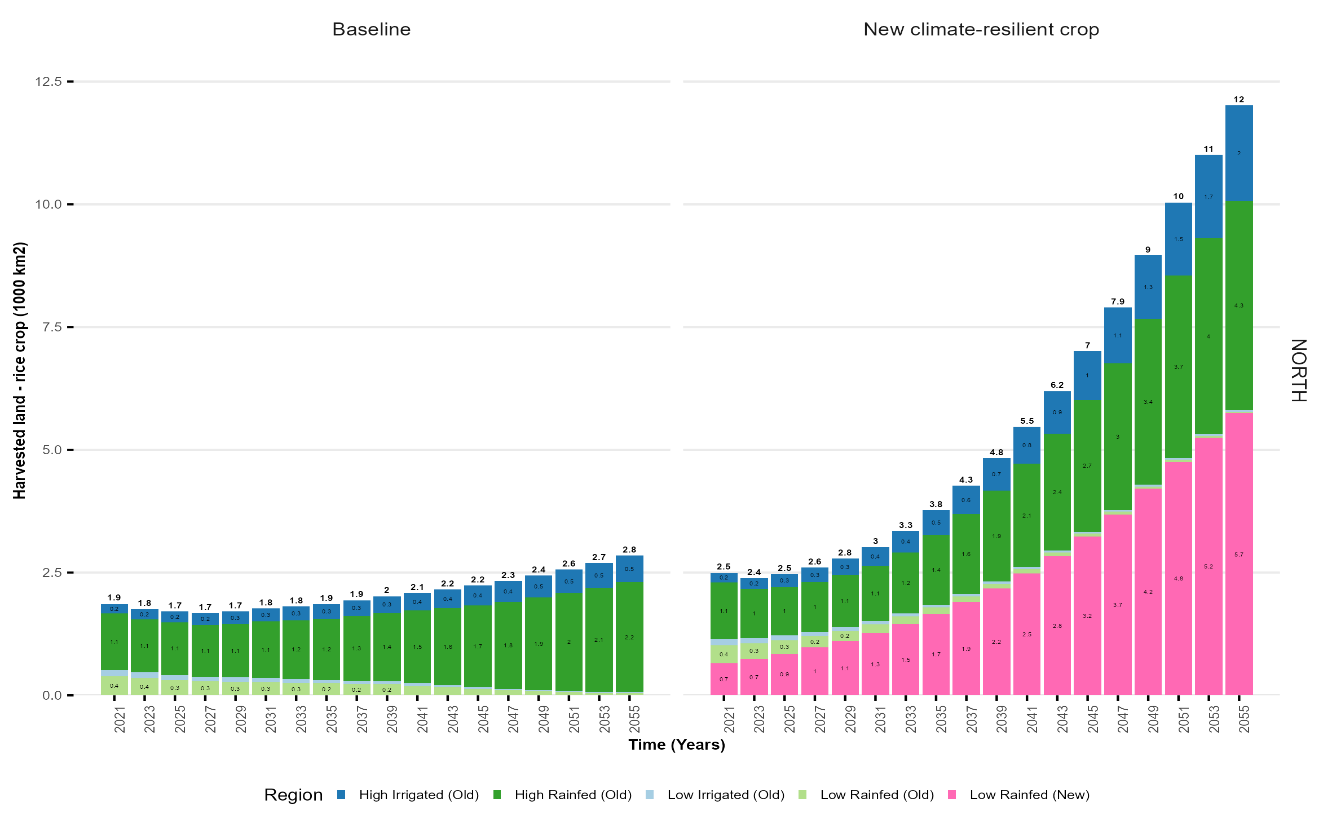
- Expand climate-resilient rainfed rice where it performs best. The nationally developed TDK11 rice variety performs particularly well in northern Lao PDR in the scenario, increasing low-input rainfed yields and lowering production costs and water use.
- Strengthen coordination and national analytical capacity. The briefs recommend regular coordination among the institutions responsible for agriculture, water, energy, environment, and land, supported by stronger systems for data collection, modeling, and scenario analysis.
Model: CLEWs, implemented in OSeMOSYS
Stakeholders: UN DESA, KTH Royal Institute of Technology, Climate Compatible Growth, National University of Laos, and national ministries and technical agencies.