
Zambia
When: 2017; 2025–2026
Purpose: Use integrated climate, land, energy, and water planning to support universal electricity access, agricultural growth, sustainable land use, and a more climate-resilient energy system through 2050.
Project development: A UN DESA–UNDP scoping mission in Lusaka on 24–25 August 2017 established interest across the agriculture, water, energy, environment, forestry, and planning institutions. A new phase began with Zambia’s first national CLEWs training workshop from 14–17 April 2025, when participants from government, the national utility, academia, and technical institutions began working with a Zambia-specific model. The resulting analysis was published in policy and technical briefs dated June 2026.
National policy context: Zambia’s 2023 Integrated Resource Plan anticipates rapid growth in agricultural electricity demand, from 1,200 MW in 2030 to 3,625 MW in 2050. It also plans for total generation capacity to grow to about 10,000 MW by 2030 and for variable renewable capacity to rise from about 3% to 33% by 2030 and 56% by 2050. These are national planning assumptions and targets—not results of the CLEWs training—and they provide the context for the newer integrated analysis.
June 2026 findings: The CLEWs scenarios examine the combined land, water, energy, cost, and emissions implications of meeting ambitious maize, wheat, and soybean production targets. The results are modelled pathways rather than forecasts.
- Coordinate investment across agriculture, water, and electricity. The briefs identify a need to mobilize about USD 18 billion through 2050 for the modelled transition, alongside coordinated support for mechanization, electricity access, and irrigation.
- Use distributed solar to support small farms. The modelled pathway installs 260 MW of distributed solar by 2030 and 370 MW by 2050 to power irrigation for about 26,130 hectares of small-scale farming.
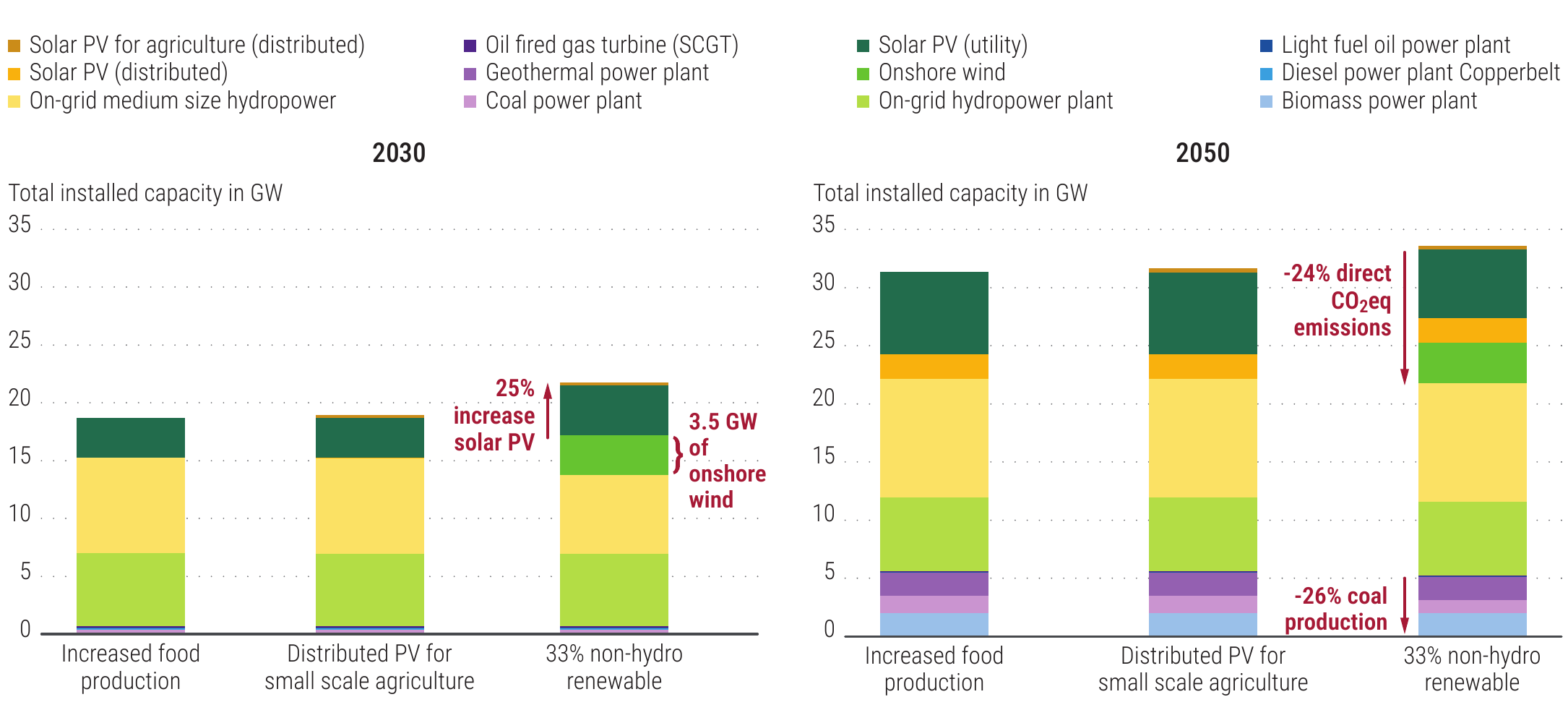
- Scale up non-hydropower renewables. In the least-cost scenario aligned with the renewable-energy target, installed capacity reaches about 4,270 MW of utility-scale solar, 260 MW of distributed solar, and 3,500 MW of onshore wind by 2030.
- Reduce exposure to coal and climate-sensitive hydropower. Compared with the agricultural-growth scenario, the faster renewable rollout reduces modelled coal generation by 26%, direct greenhouse-gas emissions by 24%, and variable electricity costs by 21% in 2050.
- Protect water resources and small farmers. Because expanded irrigation increases reliance on groundwater, the briefs call for assessment of seasonal recharge and climate risks, careful spatial planning, and measures to ensure that small farmers benefit from the transition.
Model: CLEWs, implemented in OSeMOSYS
Stakeholders: Zambian energy, agriculture, water, environment, and planning institutions; University of Zambia; Centre for Energy, Environment and Engineering Zambia; ZESCO; Energy Regulation Board; UN DESA; KTH Royal Institute of Technology; and Climate Compatible Growth.