New CLEWs policy and technical briefs for Lao PDR present the results of an integrated assessment developed with national stakeholders through workshops in November 2024 and May 2025. The June 2026 publications examine how Lao PDR can pursue its forest-cover & green-growth goals while maintaining food security and preparing agriculture for a changing climate.
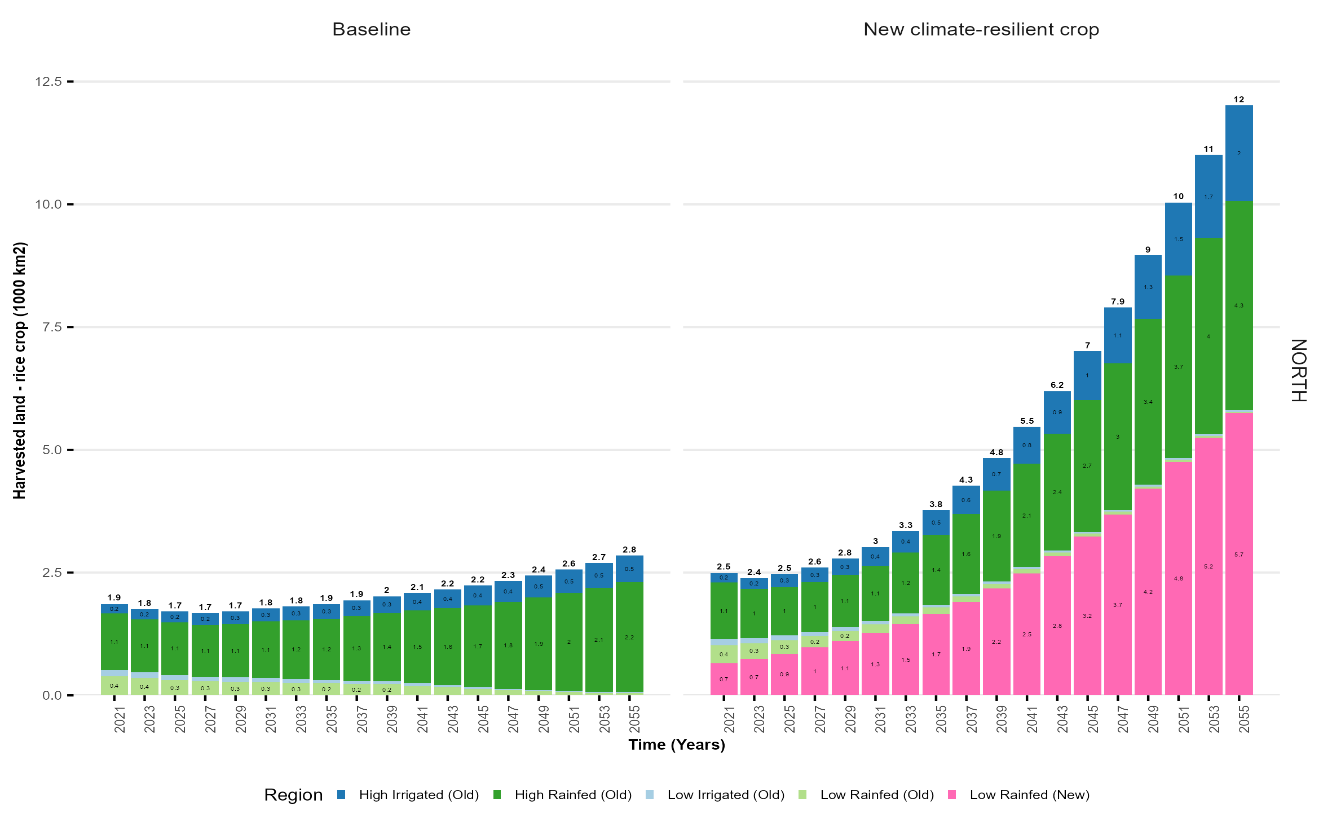
The analysis finds that using existing farmland more productively can reduce pressure to clear additional land. In the modelled pathway, expanding sustainable mechanization and irrigation could provide an additional 420,000 tonnes of rice per year by 2055 while freeing about 8,000 km² of land for other uses, including forest restoration. This transition must be planned carefully: the scenario raises water needed for irrigation by 51% and electricity needed for irrigation by 34% by 2055.
Key recommendations
- Support farmers in producing more on existing agricultural land, using appropriate mechanization, efficient irrigation, improved soil management, and productive crop varieties.
- Plan agriculture, water, and electricity investments together so that irrigation expansion does not create local water shortages or unreliable power demand. Efficient pumps and modest increases in solar and wind generation can help.
- Promote climate-resilient rainfed rice varieties, especially the nationally developed TDK11 variety in northern Lao PDR, where the model finds strong potential to increase yields while lowering costs and water use.
- Make cross-government planning routine by strengthening coordination among agriculture, water, energy, environment, and land institutions and investing in national data and modeling capacity.
The policy brief provides a concise overview for decision-makers. The technical brief documents the model, scenarios, assumptions, and detailed results. All quantitative findings are scenario results rather than forecasts.