New CLEWs policy and technical briefs for Zambia present an integrated assessment developed following the national training process launched in April 2025. The June 2026 publications examine what Zambia’s ambitious maize, wheat, and soybean production targets could mean for land, irrigation, electricity supply, investment, and emissions through 2050.
The analysis shows why agricultural & energy planning need to move together. Meeting the crop targets in the modelled pathway requires much more irrigation & electricity for pumping, while the expansion of cultivated land creates additional pressure on ecosystems & water resources. Distributed & utility-scale solar, together with onshore wind, emerge as cost-effective options for supporting agricultural electrification and diversifying a power system exposed to drought.
Key recommendations
- Coordinate agricultural, water, and energy investment. The modelled transition requires about USD 18 billion through 2050, alongside aligned support for farm mechanization, electricity access, and irrigation.
- Expand distributed solar for small-scale irrigation, reaching 260 MW by 2030 and 370 MW by 2050 to serve about 26,130 hectares of small-scale farming.
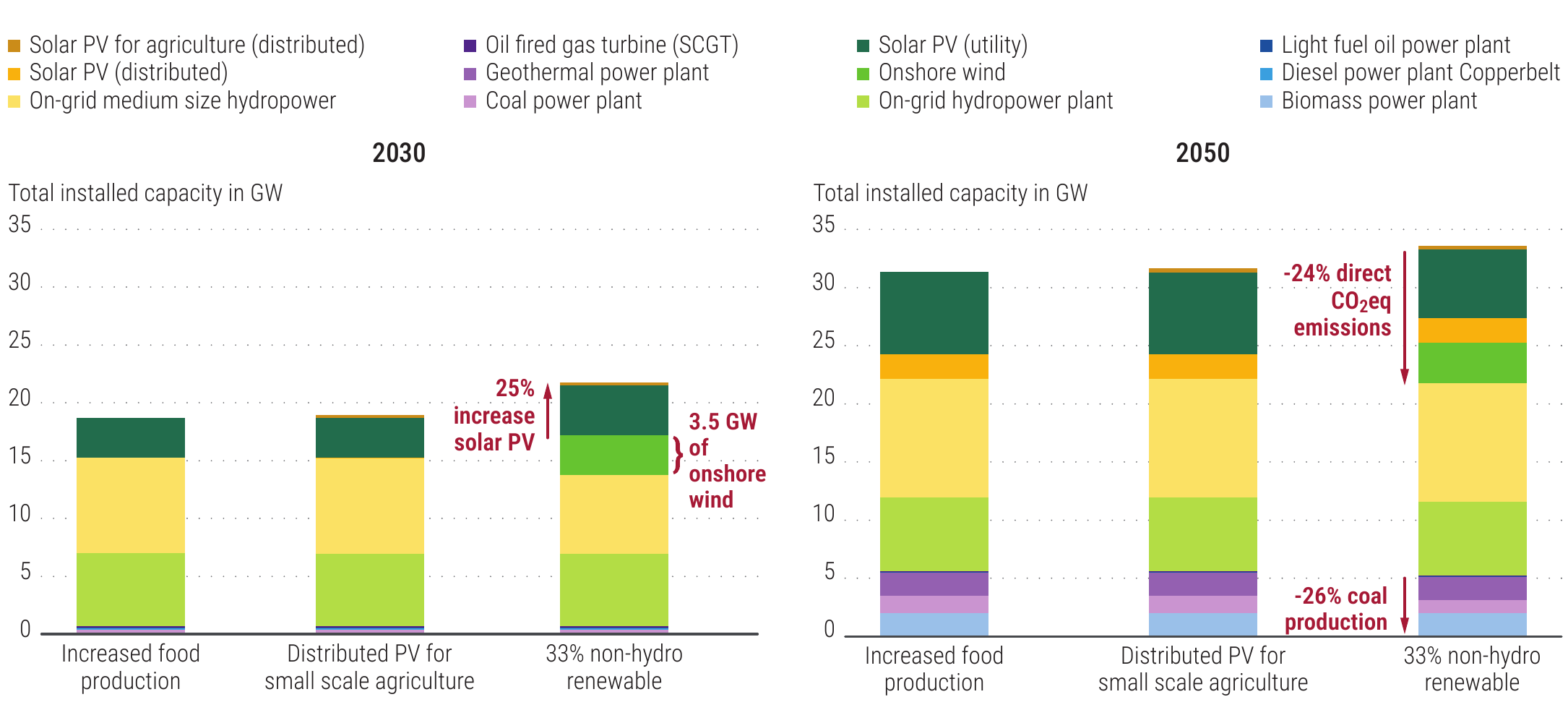
- Accelerate larger renewable-energy projects. The least-cost scenario aligned with Zambia’s renewable-energy target includes about 4,270 MW of utility-scale solar, 260 MW of distributed solar, and 3,500 MW of onshore wind by 2030.
- Reduce reliance on coal. Compared with the agricultural-growth scenario, the faster renewable rollout lowers modelled coal generation by 26%, direct greenhouse-gas emissions by 24%, and variable electricity costs by 21% in 2050.
- Protect groundwater and ensure a fair transition. Irrigation plans should account for seasonal recharge and climate risks, use careful spatial planning, and make sure small farmers benefit from new infrastructure.
The policy brief summarizes the implications for decision-makers. The technical brief provides the full model structure, scenario design, assumptions, and detailed results. All quantitative findings are scenario results rather than forecasts.