New OG-Core policy and technical briefs use the OG-ZAF model to examine South Africa’s fiscal and economic challenges. Published in June and July 2026, the briefs compare four scenarios: fiscal drag, a VAT increase, a shift in public spending from recurrent costs toward investment, and a combined package of fiscal measures and productivity-enhancing reforms.
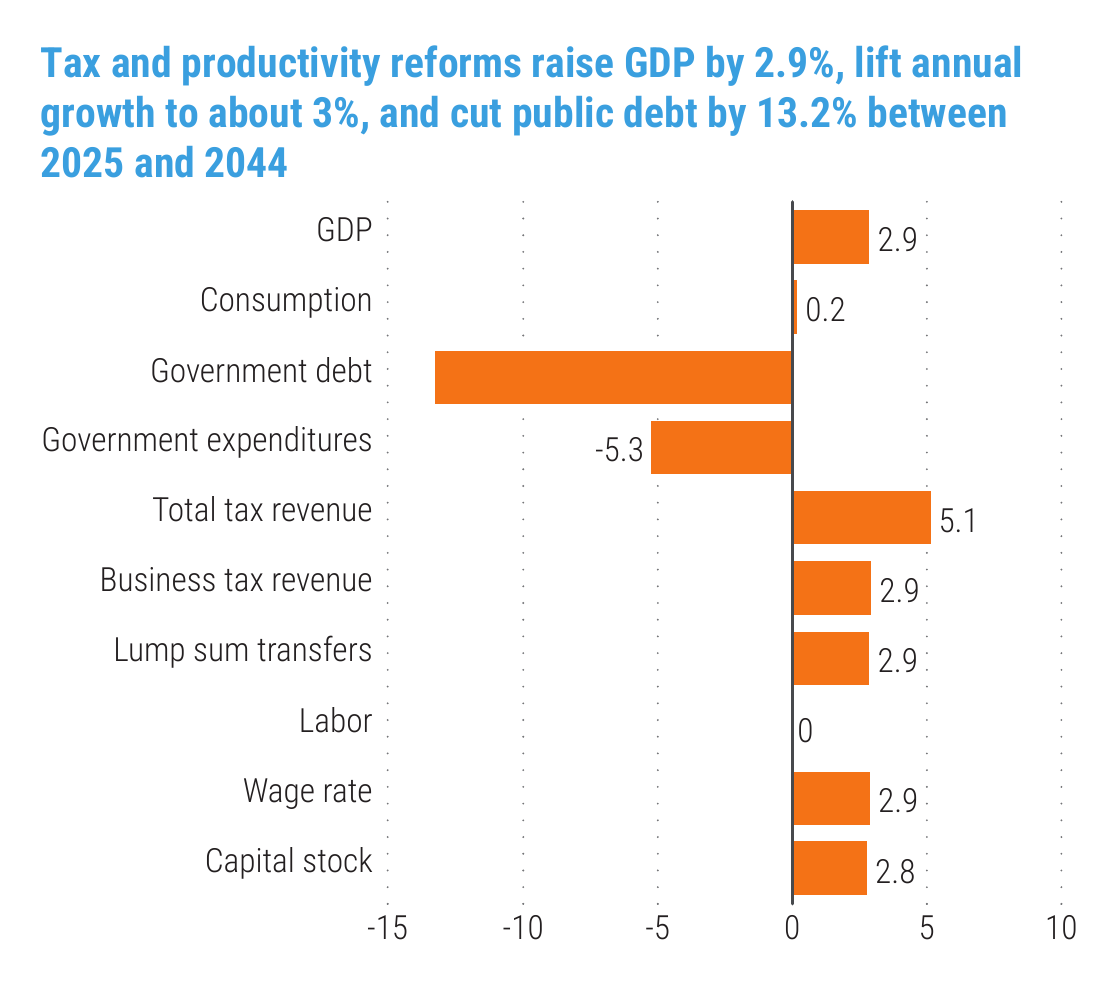
The scenario results suggest that tax increases and spending restraint can reduce debt, but fiscal action alone may also weaken consumption and do little to lift growth. In the combined scenario, reforms that raise productivity—alongside fiscal measures—produce a stronger outcome: the model shows GDP 2.9% above the baseline, annual growth of about 3%, and public debt 13.2% below the baseline over 2025–2044.
Key recommendations
- Put growth and productivity at the centre of the strategy. Improve electricity reliability, modernize rail and ports, and reduce unnecessary regulatory burdens, especially for small and medium-sized businesses.
- Shift more public spending toward productive investment. Infrastructure investment can support long-term growth, provided projects are transparent, well governed, and carefully assessed.
- Broaden the tax base instead of relying mainly on higher rates. Stronger compliance and more efficient tax administration may be more sustainable than further increases in personal or corporate tax rates.
- Use a clear and credible debt framework. Transparent fiscal rules can strengthen confidence and reduce the risk of sudden, disruptive adjustments.
- Coordinate fiscal and structural reforms. The modelling suggests that neither fiscal measures nor productivity reforms are sufficient on their own: the strongest results come from combining them.
The policy brief provides a concise summary for decision-makers. The technical brief explains the model, assumptions, scenario design, and results in detail. These findings are modelled comparisons with a baseline, not forecasts.